
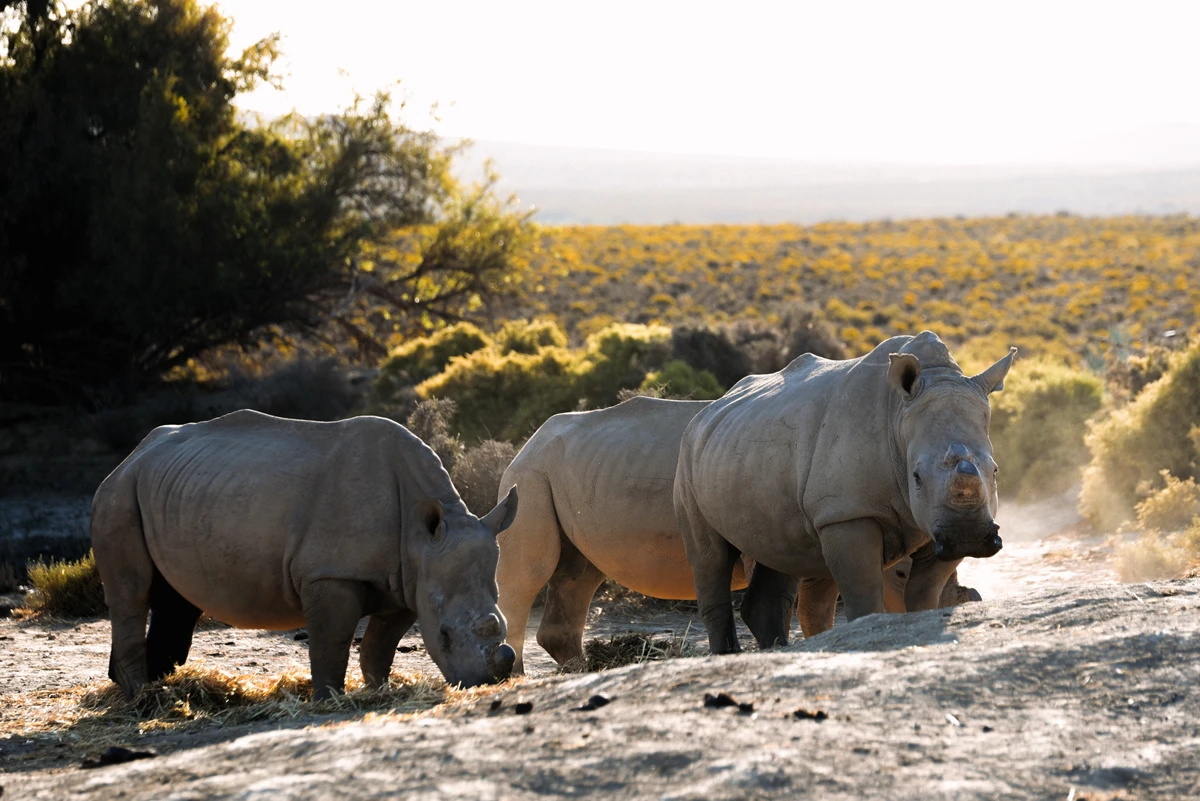
At Mont Eco Private Game Reserve, we’re witnessing something extraordinary—a rhino conservation success story unfolding across 6,750 hectares of pristine Klein Karoo wilderness. These magnificent creatures, weighing up to 2,300 kilograms and standing as Earth’s second-largest land mammals, have reclaimed their role as ecosystem architects in our malaria-free sanctuary just 2.5 hours from Cape Town.
The African white rhino embodies a beautiful paradox—immense power wrapped in surprising gentleness. Their broad, square lips, perfectly evolved for grazing indigenous Klein Karoo grasses, have earned them the endearing nickname “lawnmowers of the savanna.” This isn’t merely poetic language; it’s ecological science in action.
According to the International Union for Conservation of Nature (IUCN), white rhinos are keystone species whose grazing patterns directly influence grassland health across southern Africa. Without these gentle grazers maintaining the delicate balance of our Karoo ecosystem, the natural cycle would falter, affecting the 280+ bird species and countless mammals that call our reserve home.
“Every white rhino at Mont Eco represents a victory for rhino conservation and proof that luxury tourism can drive meaningful wildlife protection.” – Craig Saunders, Founder, Mont Eco Game Reserve
The numbers tell a story of both triumph and ongoing challenge. As of 2025, approximately 16,800 white rhinos remain in the wild globally, with South Africa hosting the vast majority—around 13,991 individuals according to the International Rhino Foundation. This represents a remarkable recovery from the species’ near-extinction in the early 1900s, when fewer than 20 southern white rhinos survived.
However, their critically endangered cousins paint a sobering picture: only 6,500 black rhinos remain across Africa, while the northern white rhino subspecies is functionally extinct with just two females under human care. These statistics underscore why every rhino conservation effort matters—and why Mont Eco’s approach represents hope for the future.
| Characteristic | White Rhino | Black Rhino |
|---|---|---|
| Population (2025) | 16,800 (Near Threatened) | 6,500 (Critically Endangered) |
| Lip Shape | Wide, square (grazing) | Pointed, hooked (browsing) |
| Weight | Up to 2,300 kg | 1,000-1,400 kg |
| Social Behavior | Social groups (“crash”) | Solitary |
| Speed | Up to 40 km/h | Up to 55 km/h |
Our rhino conservation philosophy extends far beyond traditional game reserve management. Since our founding by conservationist Craig Saunders, Mont Eco has implemented a comprehensive approach that aligns with leading organizations like WWF South Africa’s Black Rhino Range Expansion Project.
When guests choose Kingsley Lodge for their Klein Karoo safari experience, they’re not just booking luxury accommodation—they’re investing in proven rhino conservation success. A significant portion of every booking contributes directly to anti-poaching efforts, habitat preservation, and research programs that benefit rhino populations across southern Africa.

Understanding white rhino behavior and biology is crucial for effective conservation. Despite their poor eyesight (limited to about 30 meters), these magnificent creatures possess extraordinary hearing and olfactory abilities that far exceed human capacity.
Recent research published in the Nature Conservation journal highlights how white rhinos’ grazing patterns create micro-habitats essential for biodiversity. At Mont Eco, we’ve documented how rhino presence has increased indigenous plant diversity by 40% in restored areas over five years.
This ecological impact makes rhino conservation about much more than saving a single species—it’s about maintaining the intricate web of life that defines African wilderness ecosystems.
Experiencing white rhinos at Mont Eco transcends traditional game viewing. Our expert guides, with decades of combined Klein Karoo experience, possess intimate knowledge of individual rhino behavior patterns, preferred grazing areas, and social dynamics within our population.
During carefully timed game drives, guests witness white rhinos in their natural element—perhaps a protective mother guiding her calf to a favorite watering hole, or a magnificent bull surveying his territory from a rocky outcrop against the backdrop of the Langeberg Mountains.
From the luxury of our seven-suite Kingsley Lodge, guests often spot rhinos wandering past private terraces during morning coffee or evening wine—a powerful reminder that they’re staying within a living conservation success story.
Mont Eco’s rhino conservation efforts contribute to broader continental initiatives. Our data sharing with the South African National Parks research network helps inform national conservation strategies and anti-poaching technologies.
The success of our rehabilitation model—transforming agricultural land back to indigenous Klein Karoo ecosystem—has attracted attention from conservation organizations across Africa. Our approach demonstrates how private reserves can complement national parks in creating connected conservation corridors essential for genetic diversity and long-term species survival.


How many white rhinos are left in the wild in 2025?
Approximately 16,800 white rhinos remain in the wild globally as of 2025, with the majority living in South Africa. This represents a conservation success story, as the species recovered from fewer than 20 individuals in the early 1900s.
What is the difference between white and black rhinos?
White rhinos have wide, square lips for grazing grass, while black rhinos have pointed lips for browsing bushes. White rhinos are larger (up to 2,300kg), more social, and calmer. Black rhinos are smaller, solitary, and more aggressive. Both species face conservation challenges, with black rhinos being critically endangered.
How does Mont Eco contribute to rhino conservation?
Mont Eco operates 24/7 anti-poaching units, rehabilitates indigenous Klein Karoo habitat, and contributes safari booking revenue directly to conservation initiatives. Every guest visit funds rhino protection, research, and community education programs across our 6,500-hectare sanctuary.
Why are rhino horns valuable and what is being done to stop poaching?
Rhino horns, made of keratin (like human hair), are illegally valued in some cultures for perceived medicinal properties. Conservation efforts include anti-poaching patrols, advanced monitoring technology, community education, and alternative livelihood programs. Mont Eco works with national and international organizations to combat this illegal trade.
Can visitors see white rhinos during a Klein Karoo safari?
Yes, Mont Eco offers excellent white rhino viewing opportunities during guided game drives. Our expert guides know individual rhino behavior patterns and preferred locations. Sightings are common during both morning and evening drives, with the best viewing typically occurring near watering holes and favorite grazing areas.
How long do white rhinos live and how fast can they run?
White rhinos live up to 40 years in the wild, often longer in protected reserves like Mont Eco. Despite weighing up to 2,300kg, they can reach speeds of 40 km/h—faster than most humans can run. Their horns continue growing throughout their lives and can regrow if damaged.
What role do white rhinos play in ecosystem health?
White rhinos are keystone species that shape entire ecosystems. Their grazing maintains grassland health, prevents bush encroachment, and creates habitats for numerous other species. Their wallowing creates water sources, while their dung fertilizes soil and disperses seeds across vast areas, supporting biodiversity throughout the Klein Karoo.
Is Mont Eco suitable for families interested in rhino conservation education?
Absolutely. Mont Eco offers family-friendly safari experiences with educational components about rhino conservation. Our guides provide age-appropriate information about rhino behavior, conservation challenges, and success stories. The malaria-free Klein Karoo location makes it ideal for families with children of all ages.
© 2026 Mont Eco Private Game Reserve. All Rights Reserved | Privacy Policy | Web Design by LDJ